
Introductory Braiding Workshop
An introductory braiding workshop is offered by the Atelier de Tressage, located in the heart of the Marais. During these braiding sessions, you will learn what braiding is and how to set up a braiding loom. You will leave with a cord made to measure by yourself.
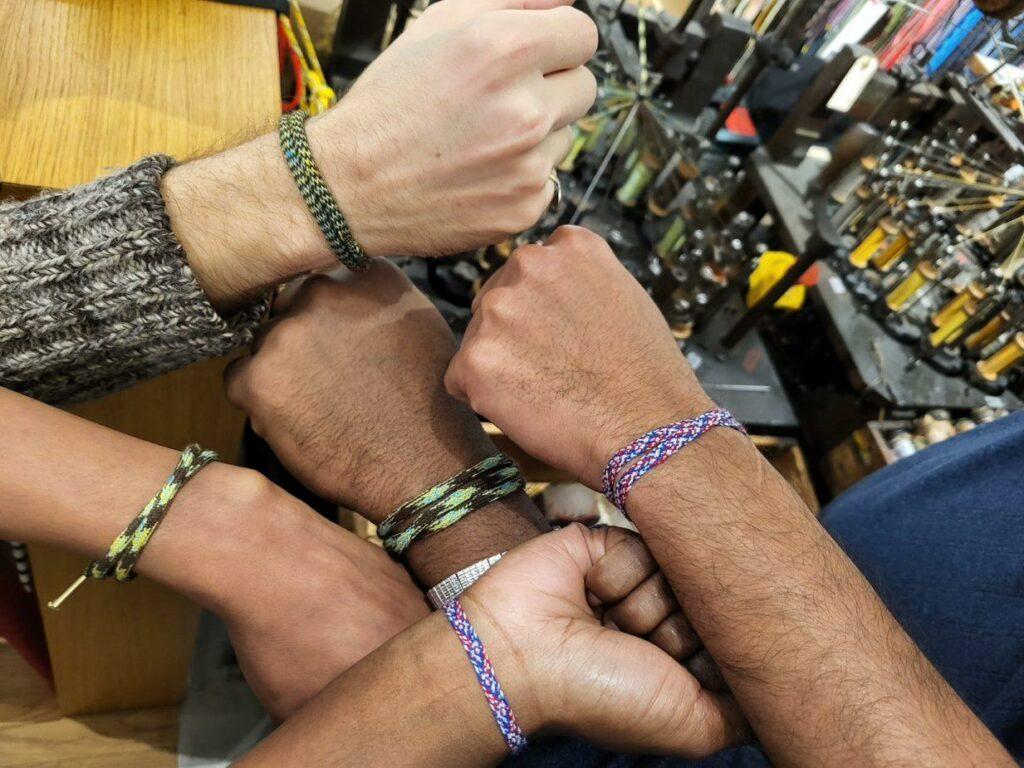
A tip is attached to this cord to form a bracelet. If we have managed to produce enough quantity, we can even make a pair of laces!
The introductory braiding workshop is a DIY class. This workshop allows you to get started with loom setup. You will leave with the product you have created and made yourself. It is therefore a fun, creative and practical workshop-training. It is also possible to privatise a time slot for a group!
Contact us for more information. So, introductory or full braiding training ? It all depends on what you plan to do with it afterwards !
The introductory braiding workshop is a practical and creative class
The braiding training offered by the workshop allows you to understand what braiding is and to make a cord yourself.
Practical information for registering for the introductory braiding workshops
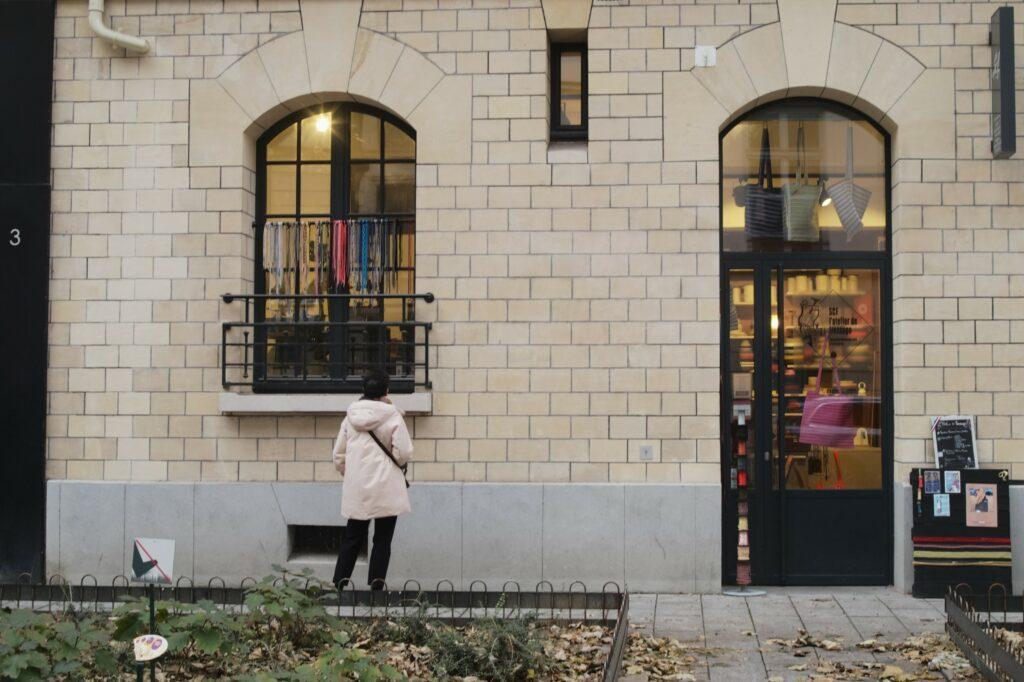
The workshop lasts between 2 to 2.3 hours. The training takes place at the Atelier de Tressage at 3 Rue Saint-Gilles, Caserne de Minimes, Paris 3rd. Maximum of 6 people – €49 per adult, €30 per teenager. The minimum age for a workshop is 16 ; however, younger participants are welcome if accompanied by an adult. A private booking is possible — feel free to suggest a date that suits you.
When are these workshops held?
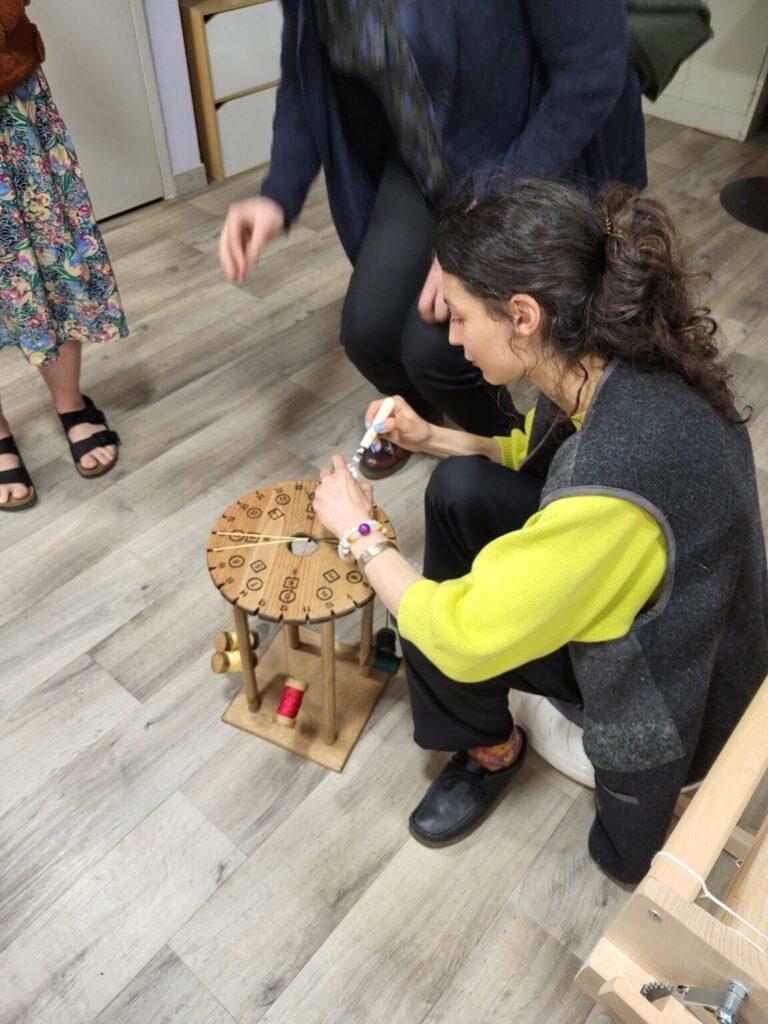
These introductory braiding workshops are offered at different times of the day depending on our trainers’ availability. You can check the available dates and times on the workshop booking page. During the training, you will set up a wooden braiding loom. The workshop is therefore a hands-on experience — you set up the loom yourself. You’ll see, it’s not as complicated as it sounds! These wooden braiding looms are mechanical and date back to 1830.
This introductory workshop also teaches how patterns are formed by the crossing of threads. During the braiding training, you move the bobbins around. Once done, you restart the loom and obtain a new design or pattern. It’s like magic!
Tips before attending the introductory braiding workshops
For these braiding training and initiation sessions, we recommend wearing simple, washable clothing. Indeed, the braiding looms are greased, and you will certainly get your hands dirty while setting up the looms — and possibly your clothes too. In addition, the threading needle used to thread the loom has an unfortunate habit of catching on clothing, slightly pulling a thread. Ideally, come to the workshop wearing an apron. If you show up in your Sunday best, we will do our best to advise you (without guarantee) so that you leave without any stains.
Thread selection and loom preparation
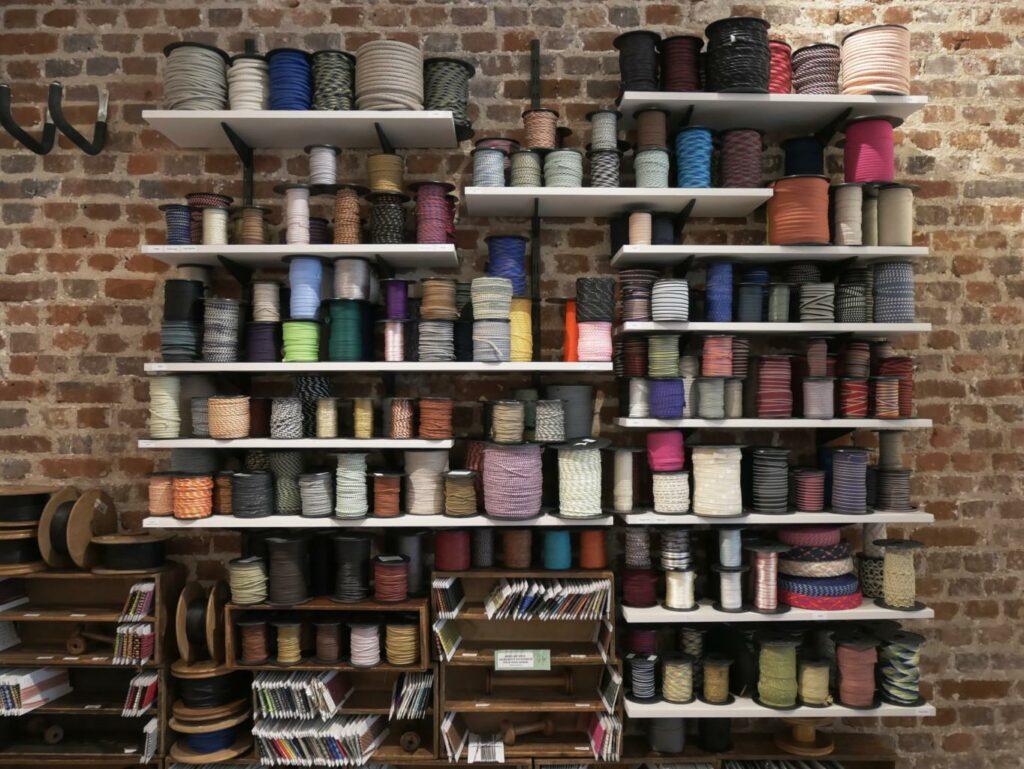
- You choose the material of the thread to be braided; the workshop offers clean materials such as recycled polyester, organic cotton, French wool (from the Tricolor collective) and French linen!
- Once the material is chosen, you select the colours. During the workshops, we recommend choosing two or more colours in order to create patterns.
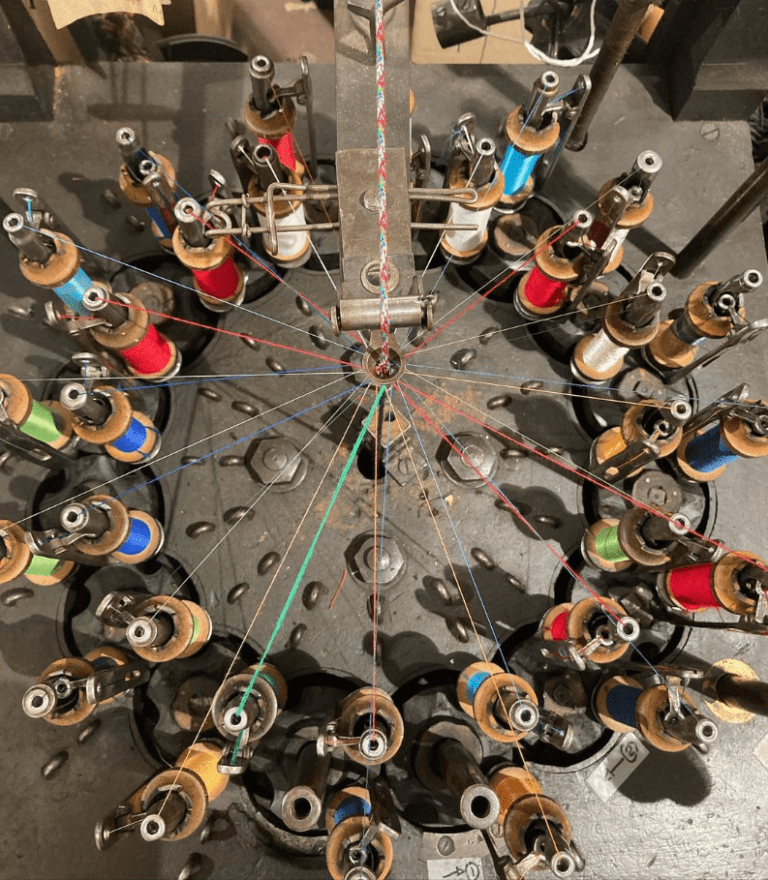
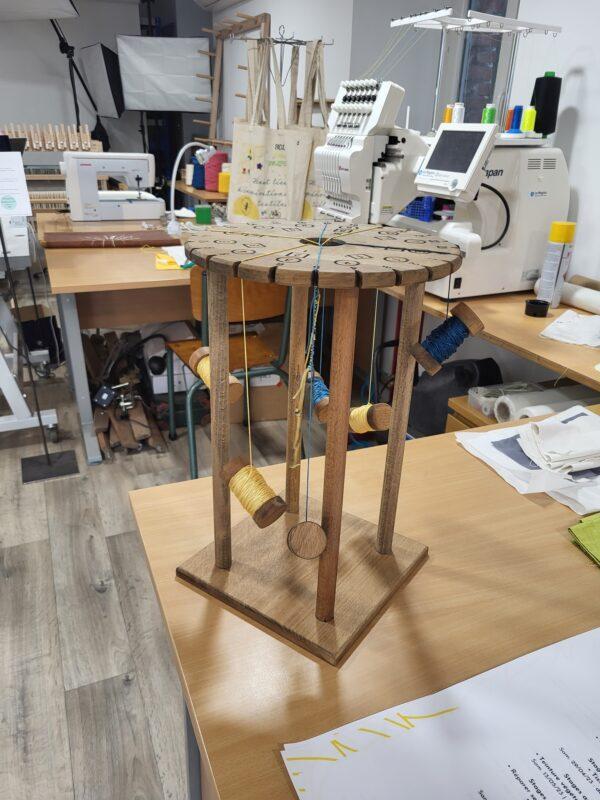
- Then, you wind the bobbins; winding is the step that consists of transferring the thread from the spool onto a small wooden piece called a bobbin. A bobbin can also be thought of as a small spool. This bobbin is the thread carrier that will be mounted onto the braiding loom.
From assembly to finished product
- You set up the braiding loom; this involves threading the thread onto the spindle. The spindle is the carrier for the bobbin. The threading is done in 4 thread passes, including the threading of the pump. The pump is a weight that regulates thread tension and also automatically stops the loom if the thread breaks.
- Then, you operate the loom. The loom runs automatically. It is connected to a wooden drum, also called a menard, by a belt. This menard rotates, driven by a small motor. While the loom is running, we discuss the history of braiding and all the possibilities it offers.
- Design! You stop the loom to move the spindles and, without dismantling it, create a new pattern. During the workshops, we typically braid 3 to 4 different designs. To see the designs, you can visit this page. You can also try to create your own design — this is where the workshop becomes truly creative!
- Production is stopped and you remove the braid from the loom. The braid is the finished output. If all goes well, the loom will have produced 3 to 4 metres of cord.
- You choose metal tips, also called aglets, available in several colours. We attach these aglets at the desired length to make, depending on your choice, bracelets, a glasses cord, a pair of laces… or whatever other use you can imagine. You then leave with the product you created during this hands-on and creative workshop.
Where do these braiding looms come from?
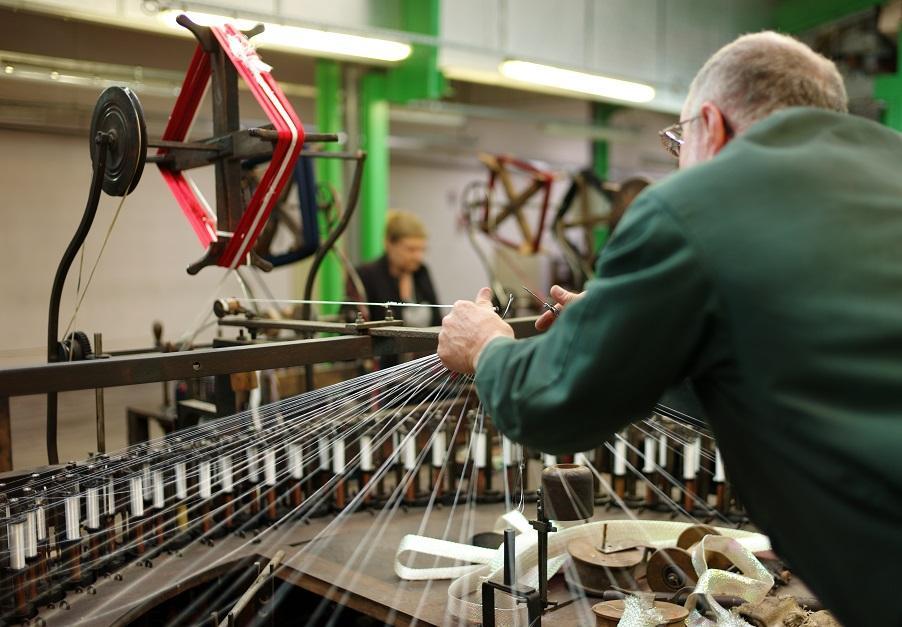
These braiding looms are production tools belonging to the Société Choletaise de Fabrication (SCF). SCF owns 1,107 of these looms, which are today housed in SCF’s factory located in Maine-et-Loire, 10 km from Cholet. The wooden braiding looms date back to 1830–1900.
If you would like to learn more, visit our page recounting their history and the various types of looms owned by SCF.
SCF has installed three looms at the braiding workshop in Paris:
- The 32-spindle loom is a classic loom with two spindle circuits, allowing the production of a tubular cord. If the centre of this cord is filled — known as a core — the cord is round or semi-round. If there is no core in the centre, the cord is flat. A flat cord is often used as a sneaker lace.
- The 21-spindle loom is a loom designed to produce a flat braid — a small, braided and flexible trim. The flat braid can be used as a bracelet, but not only…
- The 10/15/10 loom allows the production of 3 bands simultaneously. This three-band loom makes it possible to create a trim in three colours.
By offering these braiding workshops, SCF acts as an industrial trainer open to all audiences, sharing an age-old craft: braiding.
SCF shares its braiding expertise through these workshop-training sessions in order to promote and pass on its know-how. SCF holds the Entreprise du Patrimoine Vivant (Living Heritage Company) label awarded by the French state, and sees it as its duty to make braiding known and appreciated.
Braiding, a craft worth knowing — part of our everyday life
Braiding has existed since prehistoric times. A braid is an oblique interlacing of threads. The first braid you can make consists of crossing three strands of your own hair. Braiding is present everywhere in our daily lives: laces, various cords, dental floss, electrical cables, boat ropes, climbing ropes, piping, and more.
The braiding workshops on offer
The braiding workshop regularly offers sessions, either in a standard format or in a tailor-made format.
Standard introductory braiding workshop
The regular braiding workshops are open to everyone:
- You can sign up alone, with family, or with friends;
- The minimum age is 16; however, younger participants are welcome if accompanied by an adult.
The workshop is a fun, relaxed, hands-on and creative experience. It allows you to discover a rare and industrial craft and to be trained in the basics of braiding. This workshop-training lets you leave with a cord — one that you will have created and made yourself!
A great gift idea for your loved ones or yourself. Prices: €49 per adult and €30 for teenagers aged 12 to 17, for a duration of 2 to 2.5 hours.
Privatised, personalised workshops and tailor-made training
The braiding workshop organises other forms of workshop-training. It is therefore possible to arrange:
- Privatised workshops, for a group of up to 6 people. The price is fixed regardless of the number of participants at €250 for 2 to 2.5 hours;
- Advanced workshops (please contact us);
- Study projects for students or designers (please contact us). We then train the student in the handling of the braiding loom.
How to book your braiding workshop?
- There are several ways to book a braiding workshop :
- Booking space on this website, with two options:
- Two-hour workshop
- One-hour workshop
- By visiting the shop (see our opening hours on the website’s homepage)